Global Beer Production Is Falling – But Jeremy Clarkson’s Hawkstone Is Bucking the Trend
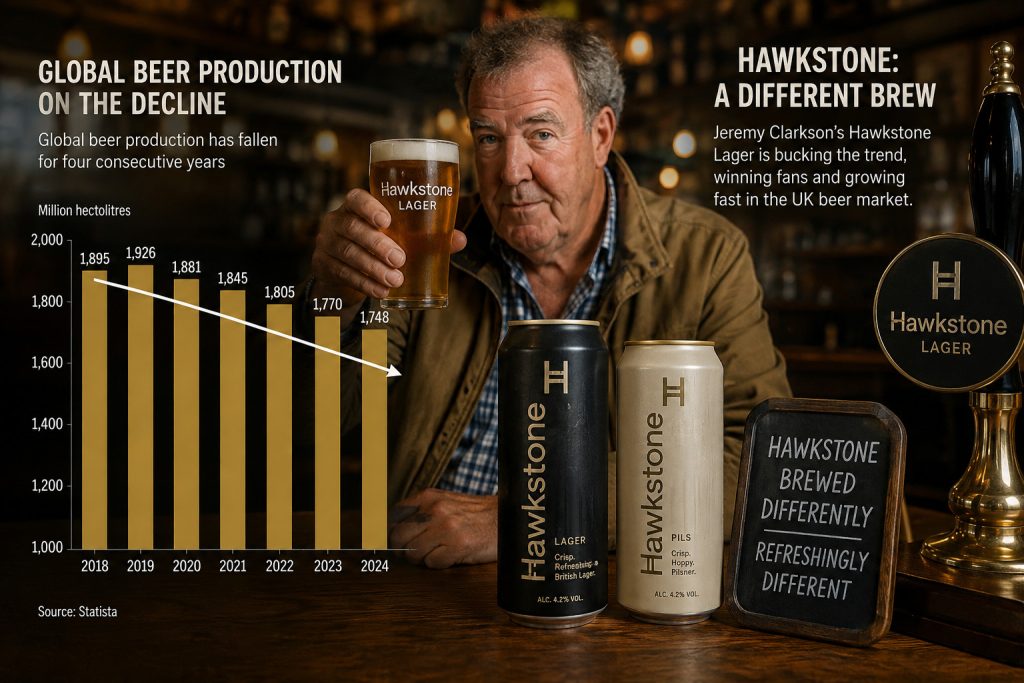
The global brewing industry is facing a difficult period, with beer production falling as changing drinking habits, economic pressures and the growth of low and no-alcohol alternatives reshape one of the world’s oldest consumer markets.
New figures published by Statista, drawing on data from the latest BarthHaas Report, show that worldwide beer production fell again during 2025.
Global brewers produced around 1.896 billion hectolitres of beer in 2025, a decline of approximately 0.7% compared with the previous year.
It follows an already subdued 2024, when worldwide beer production slipped by 0.3%, or around six million hectolitres, leaving total production just below 1.9 billion hectolitres.
The figures suggest the industry is experiencing more than a temporary post-pandemic adjustment. Beer consumption in a number of established markets is stagnating or declining, while younger consumers are increasingly exploring alternatives ranging from alcohol-free beer to spirits, cocktails and other drinks.
Statista describes the global beer industry as facing “uncertain times”, noting declining consumption in some important markets alongside rising costs for producers.
You will find more infographics at Statista
Although worldwide production remains considerably higher than it was in the late 1990s, the rapid expansion that characterised earlier decades has stalled.
BarthHaas said global production fell by 0.7% in 2025 to just under 1.9 billion hectolitres, while demand for hops also declined by almost 3%.
Thomas Raiser, managing director of BarthHaas, said:
“In many traditional markets in particular, beer consumption is stagnating or declining, while non-alcoholic and low-alcohol beverages are growing in importance.”
China Remains The World’s Beer Powerhouse
Despite declining production in some major markets, beer remains an enormous global industry.
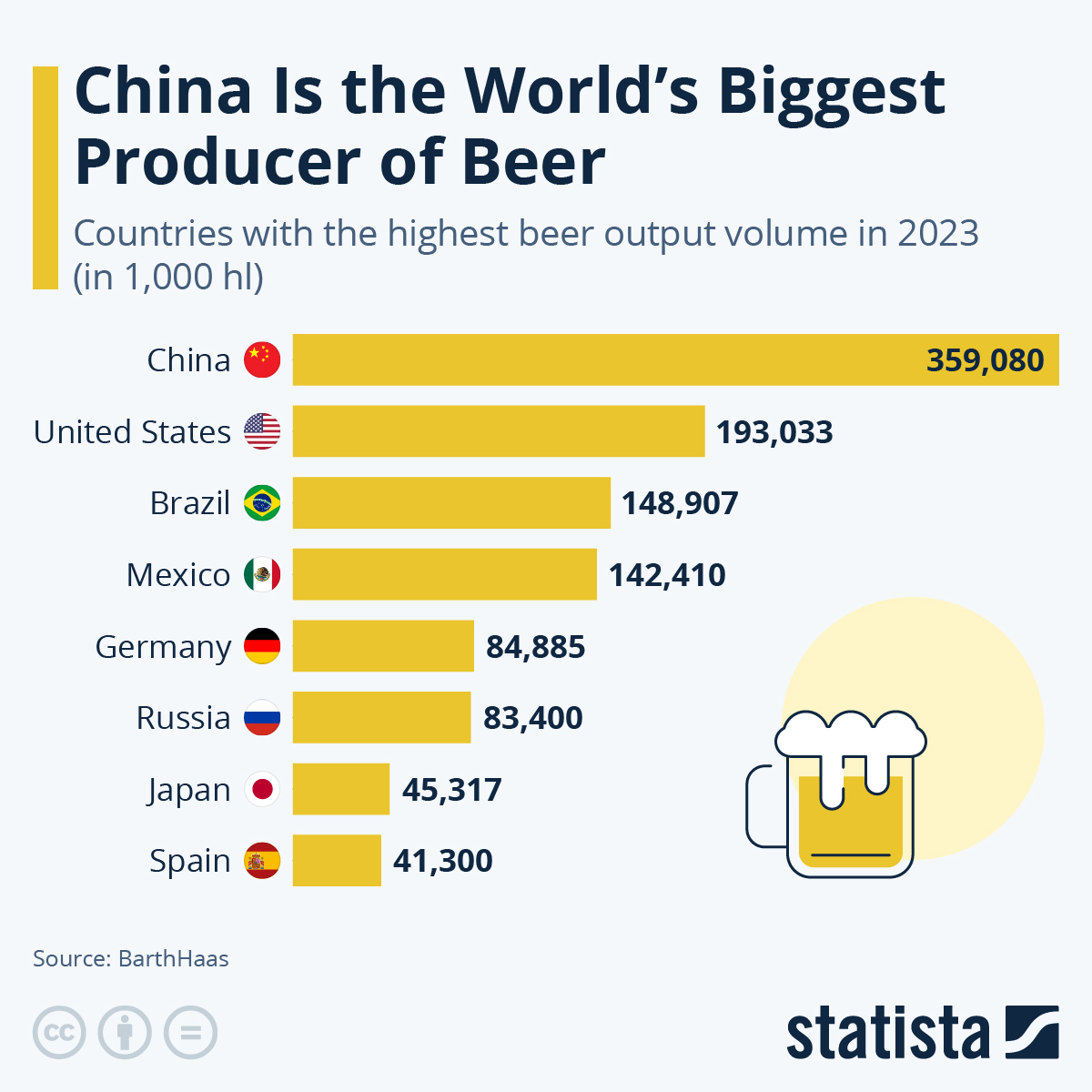
China continues to dominate global brewing. Statista’s latest figures rank China as the world’s largest beer-producing nation, followed by the United States, with Brazil also among the world’s major producers.
Statista reports that China produces more than 350 million hectolitres annually and remains comfortably ahead of the United States.
The geographical picture is not uniform, however.
BarthHaas found that production declined across virtually every continent during 2025, with Africa the notable exception, recording a modest increase.
That follows some substantial changes during 2024. Production in China fell by around 18 million hectolitres that year, while US output dropped by 9.2 million hectolitres. There was stronger growth elsewhere, including India and several African markets.
Europe – “it’s complicated!”
Europe presents a complicated picture, with mature beer-drinking nations facing changing consumer behaviour at the same time as individual brands continue to achieve remarkable growth.
And one of the most striking examples can be found in Britain.
Jeremy Clarkson’s Hawkstone Bucks The Beer Downturn
Against a clearly challenging global backdrop, the rise of Jeremy Clarkson-backed Hawkstone is particularly remarkable.
Launched in 2021 and closely associated with Clarkson’s Diddly Squat Farm and the enormously successful Clarkson’s Farm television series, Hawkstone has gone from relative newcomer to one of Britain’s fastest-growing drinks businesses.
Hawkstone’s sales increased from £7.8 million to £21.3 million in the year to March 2025, meaning revenues almost tripled in just 12 months.
The performance earned the company a place in the Sunday Times 100 ranking of Britain’s fastest-growing private companies.
And its expansion has continued.
By 2026, Hawkstone was reporting another 114% increase in sales, while the number of pubs stocking its products had doubled year-on-year to more than 4,000 venues.
It represents an extraordinary trajectory for a brand that started with a simple connection between farming and brewing.
Clarkson initially became involved with beer after looking for another use for barley grown at Diddly Squat Farm in Oxfordshire. The resulting partnership developed into Hawkstone, with Clarkson becoming its largest shareholder and one of its most effective marketing assets.
The company’s range has subsequently expanded beyond lager into products including IPA, cider and stout.
From Top Gear To Taking On Peroni
Clarkson has made little secret of his ambitions for Hawkstone.
Speaking about the company’s rapid growth in 2025, he declared that he wanted executives at Italian lager brand Peroni to be wondering what had happened as Hawkstone expanded.
It was a characteristically Clarkson-style boast, but Hawkstone’s numbers mean established brewers are unlikely to dismiss the brand entirely.
Its’ strategy is also noticeably different from simply putting a celebrity name on a beer.
Hawkstone has increasingly positioned itself around British agriculture, locally sourced ingredients and premium pricing – themes that fit naturally with Clarkson’s transformation from Top Gear presenter into one of Britain’s highest-profile advocates for farming.
The company is now backing British hop production too.
In 2026, Hawkstone announced a £2.77 million commitment to British-grown hops, involving the advance purchase of 153 tonnes of hops over three years through Charles Faram Farms.
The initiative is expected to increase UK hop production by around 15%.
The Paradox Facing Britain’s Beer Industry
Hawkstone’s success illustrates an interesting paradox within the modern beer market.
Consumers may collectively be drinking less beer, but that does not necessarily mean they have stopped being interested in beer.
Instead, spending appears increasingly capable of migrating towards distinctive products, premium brands and drinks with a compelling story behind them.
Hawkstone has several advantages in that environment.
Clarkson brings enormous recognition, while Clarkson’s Farm has introduced millions of viewers to the realities of British farming. Hawkstone can therefore connect a pint of lager with barley fields, farmers, British ingredients and the personality behind the brand in a way that multinational competitors can struggle to replicate.
The broader premium market provides other evidence of this phenomenon. Guinness, for example, has achieved strong UK growth despite the wider decline in alcohol consumption, demonstrating that individual brands can expand even when their overall category is under pressure.
Hawkstone appears to be tapping into something similar: consumers may be drinking fewer pints overall, but some are prepared to spend more on the pints and brands they actively choose.
Clarkson also enjoys experimenting, and at a recent visit to his pub we found a delicious strawberry cider – St. Rawberry, and we reassured to find it available now on a limited release.
The huge amount of visitors to his Oxfordshire pub, The Farmer’s Dog. complete with outdoor bar and home produced food vans means that Clarkson doesn’t need huge marketing trials for new products, he has a ready-made audience on site and can easily try out what works before wider distribution. This perfect drink for summer, St. Rawberry, which we were desperate to try more of, is now available on limited release – and it also score highly on the feel-good factor.. Clarkson is known for paying farmers a fair price for their raw ingredients. Perhaps consumers are simply more comfortable with drinking a brand that overwhelmingly supports British Farmers and sticks up two fingers to traditional advertising rules by getting every TV advert banned.
Who knows? Whatever the reason, the Clarkson factor is definitely working.
Is The Beer Market Shrinking – Or Changing?
That could ultimately be the more important message contained within the latest production statistics.
Global beer production falling below the levels recorded just a few years ago does not necessarily signal the demise of beer. Instead, it suggests a market undergoing significant structural change.
Low and no-alcohol products are expanding. Younger drinkers have different relationships with alcohol. Established mass-market beers face intense competition for consumer attention, while premium and personality-led brands can still achieve spectacular growth.
For the world’s largest brewing groups, declining overall production presents an obvious challenge.
For smaller producers, however, the success of businesses such as Hawkstone suggests there remains considerable opportunity for brands capable of giving consumers a compelling reason to choose one beer over another.
The global beer industry may be producing fewer pints.
Jeremy Clarkson, meanwhile, appears determined to ensure an increasing number of those that are poured in Britain have Hawkstone written on the glass.
Sources and further reading
Statista – Beer production worldwide from 1998 to 2025, based on BarthHaas Group data, published July 2026.
BarthHaas Report 2025/2026 – worldwide beer production and hop market data.
The Sunday Times – Hawkstone growth and Jeremy Clarkson interviews, 2025 and 2026.